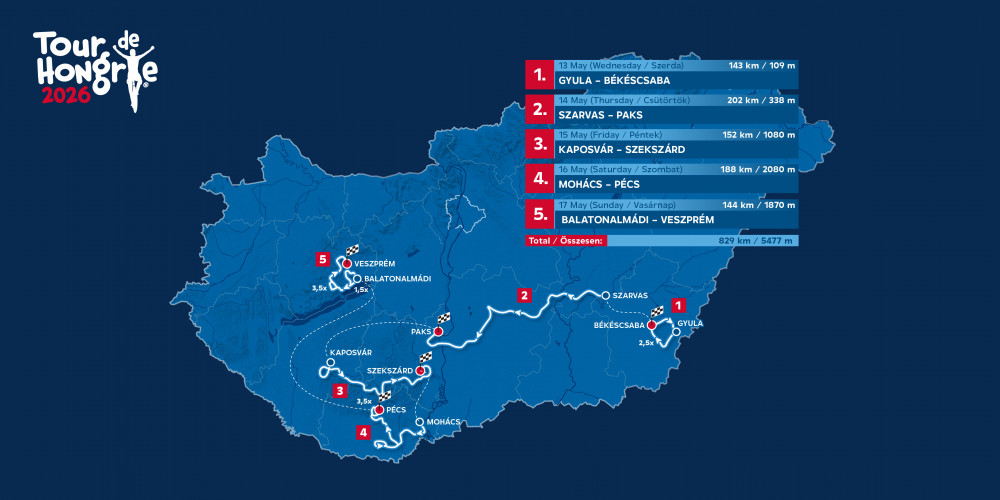
The route of the 47th Tour de Hongrie was presented on 3 February at the Budapest Music Center. This time, the race will focus on southern Hungary, with competitors facing a distance of 829 km between Gyula and Veszprém.
The event was broadcast live on national television by Duna World. Gábor Schmidt, Deputy State Secretary for Sports Administration and Development; Máriusz Révész, Secretary of State for Active Hungary; Domonkos Schneller, President of the Hungarian Cycling Federation and Károly Eisenkrammer, General Director of Tour de Hongrie gave speeches at the event. Hungarian riders also took part, including János Pelikán (Team United Shipping) and reigning Hungarian Champion Márton Dina (MBH Bank CSB Telecom Fort).
Tour de Hongrie 2026 is organised by the Hungarian Cycling Federation, Vuelta Sports Office and the National Event Management Agency, with the support of the Active Hungary programme and the State Secretariat for Sport of the Ministry of Defence.
About the route:
Stage 1 (Gyula – Békéscsaba, 143 km)
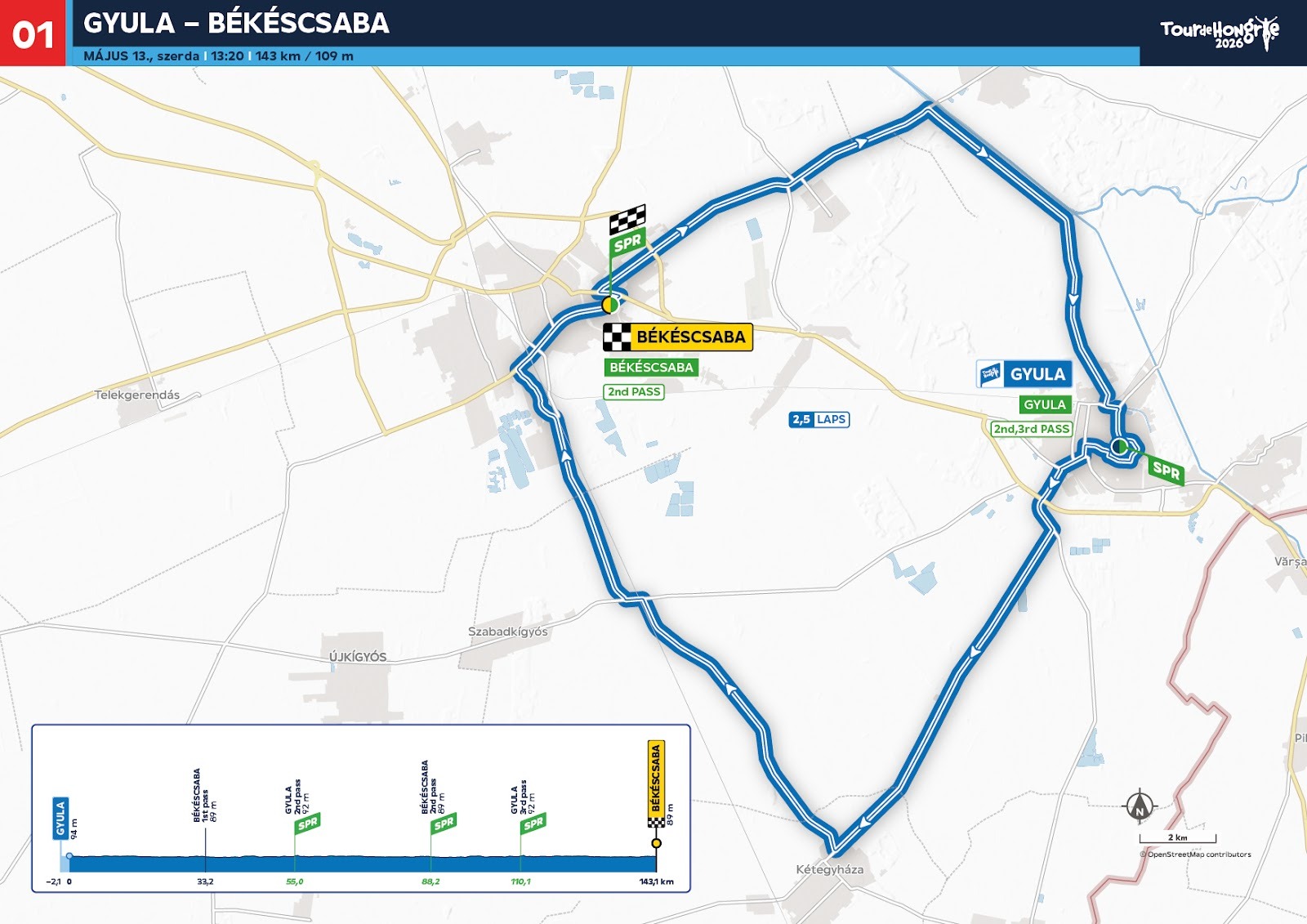
Start: 13 May 2026 (Wednesday) 13:20 (CET), Gyula Castle
Finish: ~16:30 (CET), Békéscsaba, Bajza Street
Elevation gain: 109 m
Tour de Hongrie 2026 will start from Békés County for the first time since 2005. From Gyula, the caravan will head towards Kétegyháza and then Békéscsaba, before returning to the start location from Doboz. The peloton will finish in Békéscsaba after 2.5 laps. The 143-kilometer, completely flat stage could be made chaotic by the wind, but it is likely that the sprinters will battle it out for the first yellow jersey of TdH.
Gyula will be a host city of the Tour de Hongrie for the first time. One of the most famous sights of the historic spa town and resort, Gyula Castle will provide a picturesque backdrop not only for the start, but also for the Team Presentation on 12 May. Two intermediate sprints will also take place in the hometown of Nobel Prize-winning author László Krasznahorkai.
Békéscsaba will host the Tour de Hongrie for the 10th time. One of the great historical bastions of Hungarian cycling joined the race circuit in 1935, and in addition to three starts and six finishes, the last team time trial of the race to date was also held here. The peloton last visited the seat of Békés County in 2005, when German champion Gerald Ciolek won.
Stage 2 (Szarvas – Paks, 202 km)
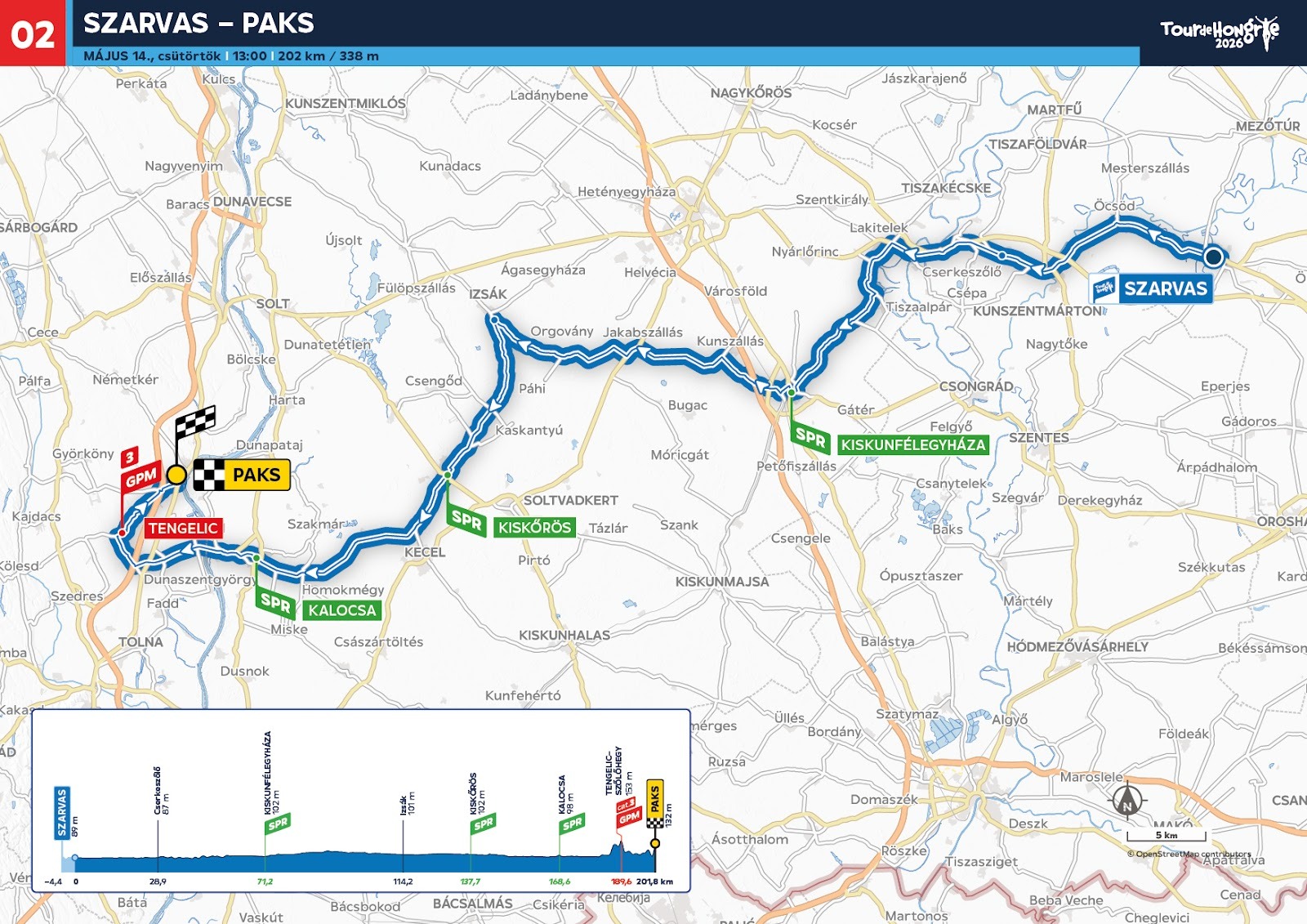
Start: 14 May 2026 (Thursday) 13:00 (CET), Szarvas Water Theatre
Finish: ~17:30 (CET), Paks, Kishegyi Road
Elevation gain: 338 m
On May 14, another city will make its debut as host of Tour de Hongrie. The peloton will head west from Szarvas and, after three Intermediate Sprints, crosses the Danube at Kalocsa. In the final kilometers, the sprinters will first have to tackle the race's first categorized climb, followed by the final kilometer in Paks, which has a gradient of 7%.
The Szarvas Water Theater will provide a fitting backdrop for Tour de Hongrie’s first visit in Szarvas. On the banks of the Holt-Kőrös River, next to the arboretum, the peloton will complete a short slow start lap before leaving the city in the direction of Békésszentandrás.
Paks is hosting the race for the second time. In 2017, the start of the third stage was held in Tolna County's largest city, with Finland's Matti Manninen winning the finish in Cegléd. However, Paks is a newcomer as a destination, so the short but steep climb up Újtemplom Street and Kishegyi Road will be a novelty for everyone.
Stage 3 (Kaposvár – Szekszárd, 152 km)
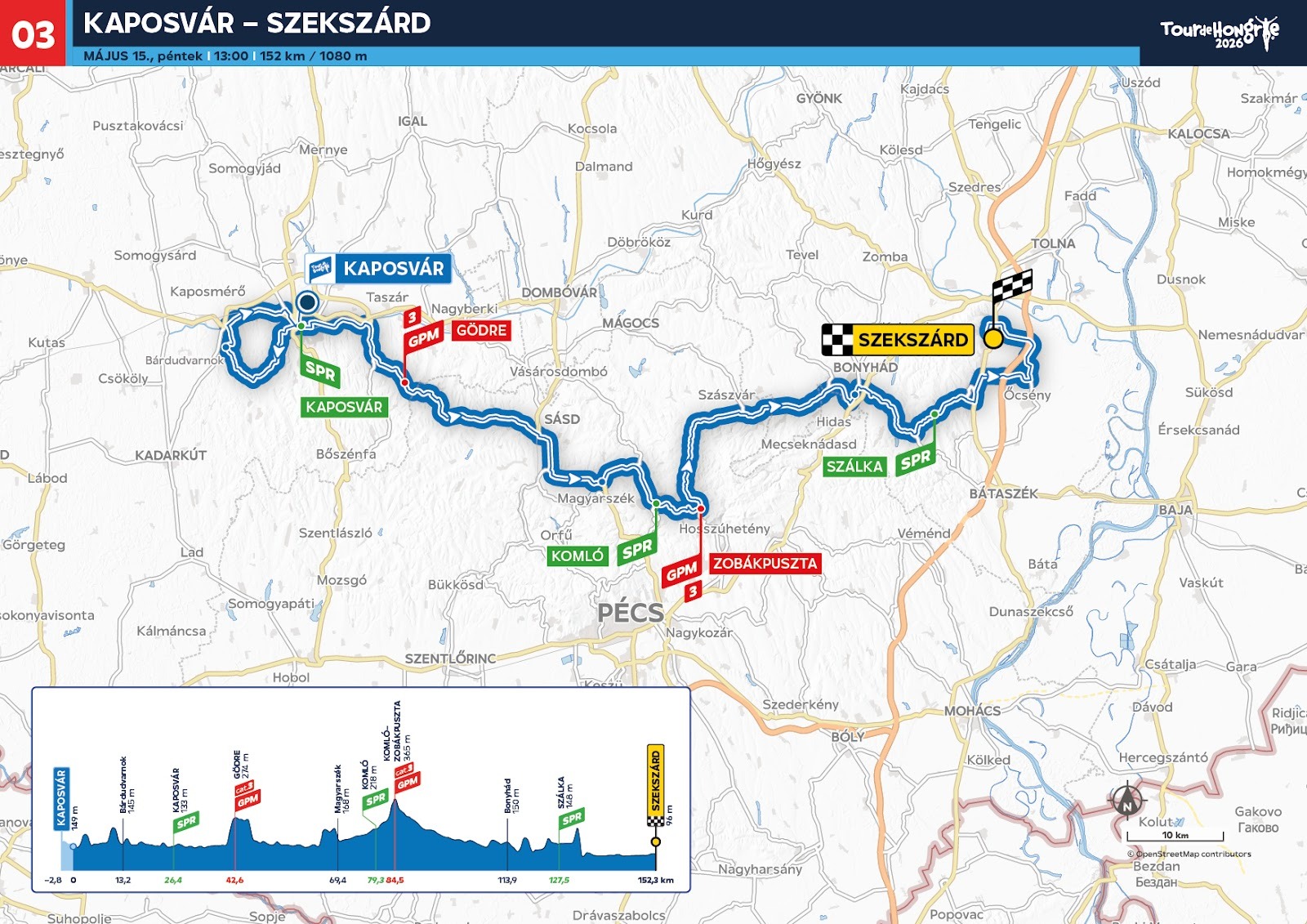
Start: 15 May 2026 (Friday) 13:00 (CET), Kaposvár Arena
Finish: ~16:30 (CET), Szekszárd, Szent István Square
Elevation gain: 1080 m
Another flat stage awaits the sprinters on May 15. Stage 3 of Tour de Hongrie starts in Kaposvár, then continues eastward after a short loop around Zselic. Before the finish in Szekszárd, the riders will face 152 km, three Intermediate Sprints and two categorised climbs, as well as an elevation gain of more than 1000 meters.
With four starts and five finishes behind it, Kaposvár is already considered an experienced Tour de Hongrie participant. Ahead of its tenth appearance, the city has also hosted the Giro d'Italia: during the 2022 Grande Partenza, the third stage started from one of the most important centers of Transdanubia. Almost 100 years ago, in 1935, a finish was already held on the banks of the Kapos River, which was our last starting city in 2023.
Szekszárd is one of the most important cradles of Hungarian cycling. The center of Tolna County has hosted prestigious competitions in recent years, such as the Gemenc Grand Prix, but the city has been bypassed for the past 23 years. The peloton has only visited the slopes of Szekszárd, also famous for its wines, four times, with Mikhail Chorniy winning here last in 1993.
Stage 4 (Mohács – Pécs, 188 km)
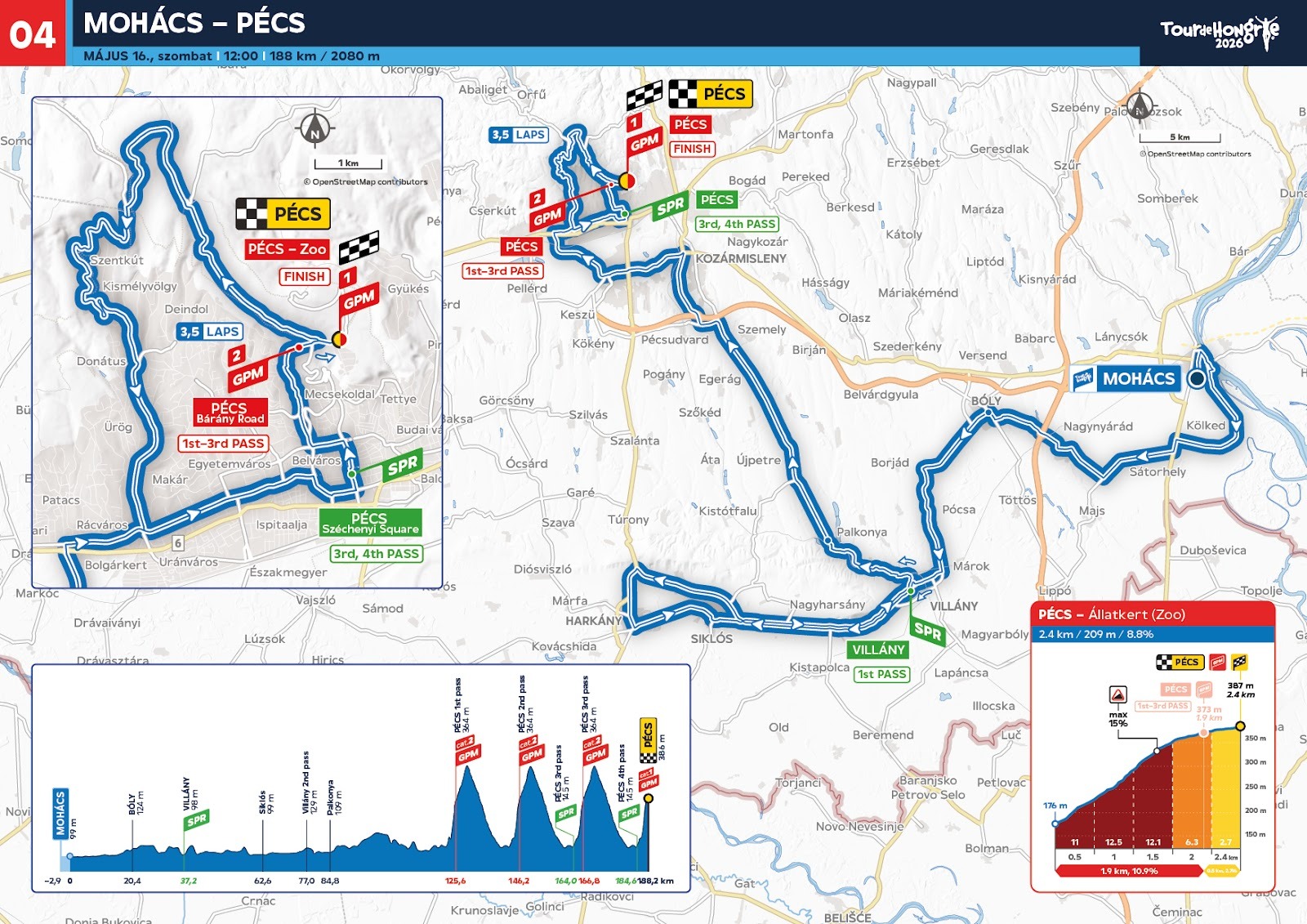
Start: 16 May 2026 (Saturday) 12:00, Mohács, Deák Square
Finish: ~16:30 (CET), Pécs, Zoo
Elevation gain: 2080 m
The most difficult stage of Tour de Hongrie 2026 will take place on May 16. After the start in Mohács, the peloton will turn towards the Villány Mountains, a region rarely visited by the Tour de Hongrie. After the Villány-Harkány-Siklós loop, the riders will arrive in Pécs, where they will have to tackle the dreaded Bárány Road climb four times before reaching the finish line in front of the Zoo. The 188 km long stage, with an elevation gain of more than 2000 meters, will be crucial for the overall victory.
Mohács will mark a historic anniversary in 2026: exactly 500 years ago, one of the most important battles in Hungarian history, the Battle of Mohács, took place here. Alongside Gyula and Szarvas, the city is the third location in this year's race that has never hosted Tour de Hongrie before.
Pécs will be the most experienced host of the Hungarian Tour in 2026: this will be the 14th finish at the foot of the Mecsek Mountains, which has previously hosted 8 starts as well. The 5 km long Lapis climb, including the nearly 2 km long Bárány Road with an 11% gradient, is the most difficult mountain on the route. The city circuit also rewards aggressive riders twice: they can collect bonus seconds in two Intermediate Sprints on Széchenyi Square. The county seat of Baranya has hosted two mountain-top finishes so far: Marc Hirschi triumphed in front of the Zoo in 2023, followed by Wout Poels a year later.
Stage 5 (Balatonalmádi – Veszprém, 144 km)
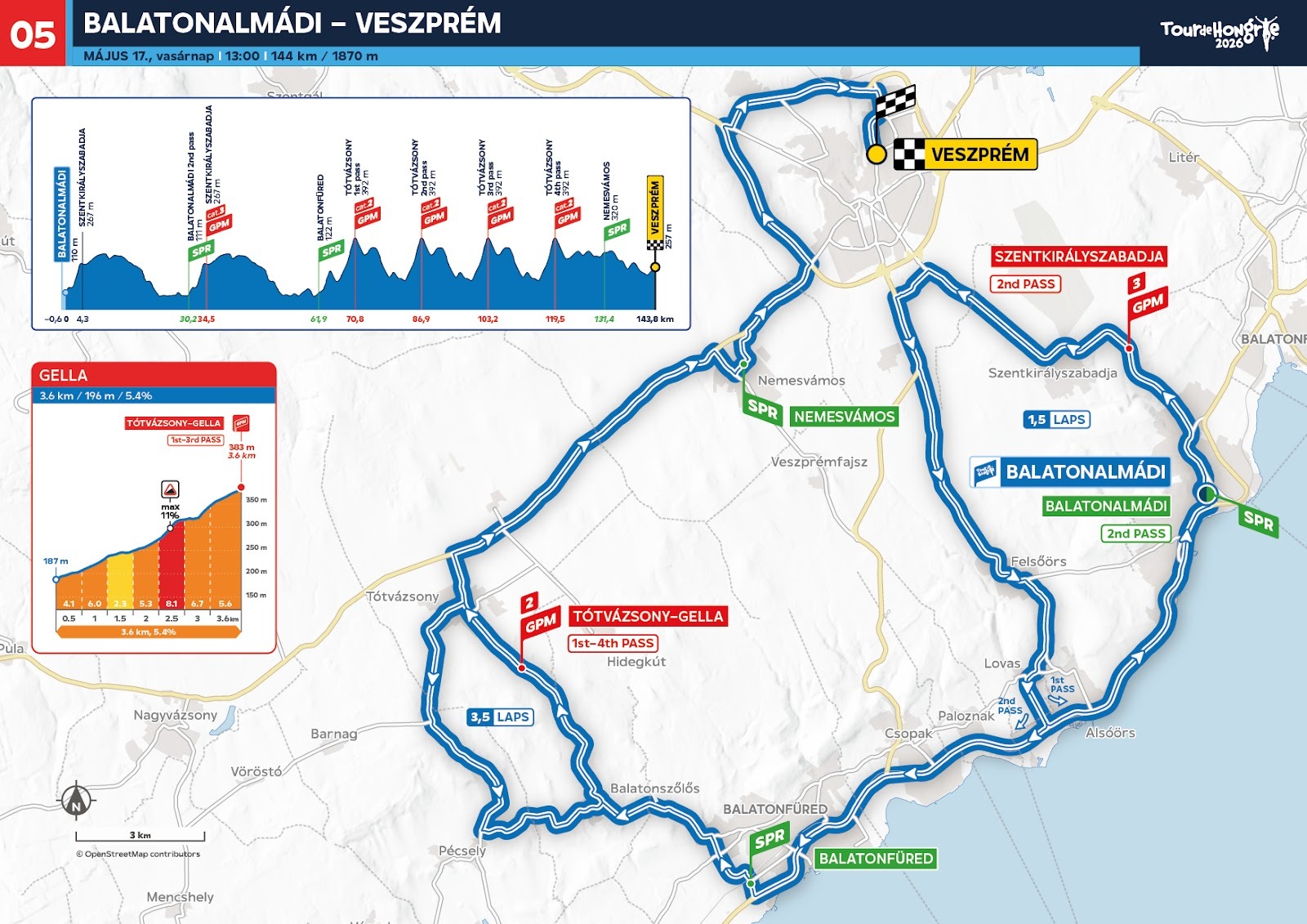
Start: 17 May 2026 (Sunday) 13:00 (CET), Balatonalmádi, Wesselényi Beach
Finish: ~16:30 (CET), Veszprém, Jutasi Road
Elevation gain: 1870 m
The 47th Tour de Hongrie will conclude on May 17 with an unpredictable stage reminiscent of Belgian one-day races. The venue will be the "European Capital of Sport" – a title awarded to Veszprém and the Balaton region for 2026. The competitors will have to tackle the steep climb of Szentkirályszabadja (2.1 km; 5.6%) twice and Gella (3.6 km; 5.4%) four times between Balatonalmádi and Veszprém. Despite the short distance of only 144 kilometers, the stage has an elevation gain of almost 2000 meters, and with three Intermediate Sprints, it offers ideal terrain for early attacks.
Balatonalmádi is one of the most important tourist centers on the northern shore of Lake Balaton. The town has previously hosted a stage start on one occasion: in 2018, the first stage following the prologue in Siófok started from the northeastern tip of the "Hungarian Sea."
Veszprém is the only town on this year's route that also hosted Tour de Hongrie in 2025. Four prologues, four starts, and two finishes have been held in the "City of Kings" so far. Zoltán Remák (2005) won the last prologue here, while Tibor Valter (1996) won the last road race.


Vuelta Ltd.

1103 Budapest, Hangár utca 10.

Tel. : +36-1 / 273-18-61
Mobile : +36-30-858-9727
Copyright © Tour de Hongrie Privacy Jobs Contact Us Old version